Eyes Made for Darkness
Finnegan Flynn
| 17-03-2026
 · Animal team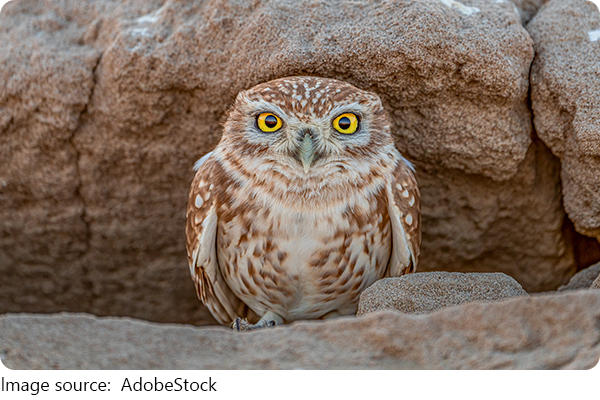
When you walk through a quiet field at night, the darkness can feel overwhelming. Shapes blur, depth vanishes, and even familiar paths look unfamiliar.
Yet, for an owl perched on a branch, that same darkness is no obstacle—it's an advantage. Their night vision isn't just good; it's extraordinary, allowing them to see and hunt with precision while the rest of the world sleeps.
The Power of Large Eyes
Owls have eyes that seem almost too big for their heads, and that's exactly the point. The larger the eye, the more light it can capture, and in the dark, light is everything. Their eyes are packed with rod cells, specialized light-sensitive cells that thrive in dim conditions. While humans struggle to distinguish shades of gray at night, owls can detect the faintest movements, like a mouse rustling under leaves. Their forward-facing eyes also give them binocular vision, which helps them judge depth accurately—a crucial skill when swooping down on prey in near-total darkness.
A Fixed Gaze with a Flexible Neck
Unlike humans, owls cannot roll their eyes inside their sockets. Their gaze is fixed forward, which might seem limiting at first. But nature compensated by giving them an incredibly flexible neck. An owl can rotate its head about 270 degrees safely, thanks to unique skeletal and vascular adaptations. This ability lets them keep their eyes locked on a target while still surveying a wide area, blending sharp focus with broad coverage. It's like having a spotlight in the dark that can swivel nearly all the way around.
Hearing That Complements Sight
Night vision alone doesn't tell the whole story. Owls also rely on exceptional hearing to complete the hunting equation. Many species have asymmetrical ear placements, one ear higher than the other, helping them detect the vertical position of sounds. Combine this with their ability to pinpoint direction, and owls can track prey they can't even see. In the dark, vision and hearing work together like a well-rehearsed duet. A faint squeak or rustle, paired with a glimpse of movement, gives the owl all it needs to strike.
Silent Flight: The Final Advantage
Even the best eyesight and hearing would fall short if the owl couldn't approach quietly. Their wings have specialized feather structures that reduce turbulence and muffle sound, allowing owls to glide almost silently. Imagine being a mouse: you might hear a breeze in the grass, but not the predator gliding inches above. The combination of silent flight and sharp night vision makes owls masters of surprise.
Why This Matters Beyond the Owl
Understanding owl night vision isn't just about admiring a fascinating bird. It has inspired human technology too. Engineers study their eye structure to improve low-light cameras, and their feather adaptations have influenced quieter aircraft designs. Owls remind us that survival often comes down to adapting better than the competition, and in their case, turning the night into an ally.
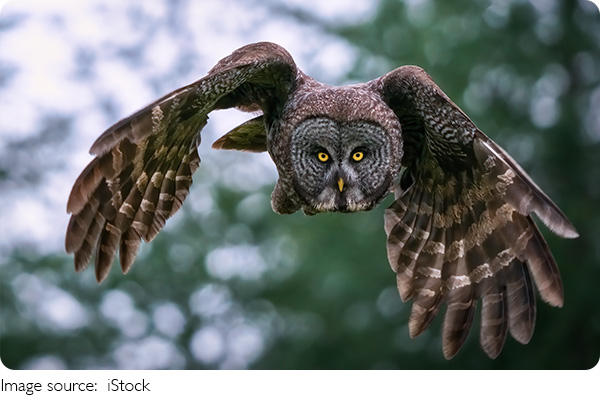
When you look up at the night sky and catch the silhouette of an owl in flight, remember you're witnessing more than a hunter—it's a creature shaped by millions of years of refinement. Their night vision is not only a tool for survival but also a reminder of nature's ability to perfect solutions in ways we can only hope to imitate. And maybe, next time you step outside at night, you'll see the darkness not as an obstacle, but as a space filled with hidden life waiting to be revealed.