Grey Heron Hunter

Pankaj Singh
| 13-04-2026
 · Animal team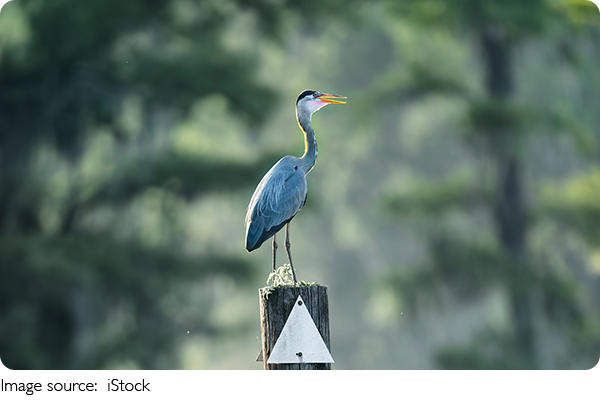
Let’s step into wetlands found across the world, from quiet riverbanks to vast marshlands. In these calm landscapes, we often encounter a remarkable bird that seems almost like part of the scenery at first glance.
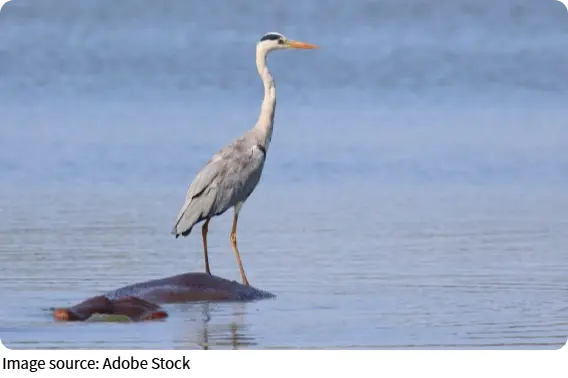
The grey heron stands still in shallow waters, blending naturally with reeds, reflections, and misty horizons. We may find it in many regions across continents, wherever water is calm and life is rich.
Despite its wide presence, it always keeps a calm and distant presence, as if it belongs entirely to the rhythm of nature itself. Observing it gives us a sense of peace and focus that is rare in fast-moving environments.
Striking Appearance and Natural Elegance
The grey heron has a tall and elegant body structure that makes it easy to recognize. Its feathers are mostly soft grey, balanced with lighter tones on the neck and chest. Dark accents on parts of its head and wings create a natural contrast that enhances its refined appearance.
When we observe it closely, we notice long, thin feathers extending from the back of its head once it reaches maturity. These delicate feathers move gently with the wind, giving the bird a graceful silhouette. Its long legs and stretched neck allow it to stand still for long periods in shallow water, perfectly adapted for its lifestyle.
Its sharp eyes are especially impressive. They are constantly scanning the water surface, detecting even the smallest ripple or movement beneath.
Mastery of Patience in Hunting
One of the most fascinating traits of the grey heron is its hunting method. Instead of chasing actively, it relies on patience and stillness. We often see it standing almost motionless, waiting for the right moment.
This strategy is highly effective in wetland environments. When small aquatic creatures move within reach, the bird reacts instantly. Its long neck allows for a fast, precise strike, completed in a single fluid motion.
In some cases, we observe even more interesting behavior. The grey heron may drop small natural items onto the water surface. This action can attract curious movement beneath the water. When prey approaches out of curiosity, the bird takes advantage of the opportunity with perfect timing. This shows not only patience but also adaptability and problem-solving ability in the wild.
Efficient Feeding Behavior
After capturing its prey, the grey heron handles it with careful and practical movements. Because its food is often slippery, it adjusts its grip before swallowing to ensure efficiency and safety.
We can observe how every action is controlled and purposeful. Nothing is rushed or wasted. This feeding process reflects how well the bird is adapted to its environment, where precision is more important than speed.
Nature has shaped it into a highly skilled hunter, capable of balancing patience with quick reaction when needed.
Wetland Habitats Around the World
The grey heron is found in many wetland regions worldwide. It lives in environments such as shallow lakes, slow-moving rivers, coastal marshes, and reed-filled wetlands. These areas provide both shelter and food sources, making them ideal habitats.
We often notice that it prefers open spaces with clear visibility over water. This allows it to observe movement easily and respond quickly when necessary. Even in different climates and regions, its behavior remains consistent, showing strong adaptation to varied environments.
For us, seeing a grey heron in the wild often feels like witnessing a quiet moment of balance in nature, no matter where we are in the world.
A Lesson in Stillness and Awareness
As we reflect on the grey heron, we begin to understand the deeper meaning behind its behavior. It does not rely on speed or noise. Instead, it depends on awareness, timing, and patience.
For Lykkers, this bird offers a simple but powerful reminder. In our daily lives, moments of stillness can bring clarity. Like the grey heron, sometimes waiting and observing carefully can lead to better results than rushing forward.
When we next find ourselves near a wetland anywhere in the world, let’s take a moment to pause. We might see this quiet hunter standing still in the water, reminding us that patience is also a form of strength.