Black Brow 5 Secrets!

Lucas Schneider
| 22-05-2026
 · Animal team
The Black-browed Albatross stands out in the Southern Ocean for its distinctive dark “eyebrow” and mastery of long-distance gliding. It thrives across vast, wind-driven waters from the Antarctic Peninsula to subantarctic islands, where few species can endure.
Despite its large global population, it is classified as Near Threatened due to ongoing pressures. These risks are driven mainly by human activities, especially fisheries, rather than natural environmental limits.
1. Built for Endless Air
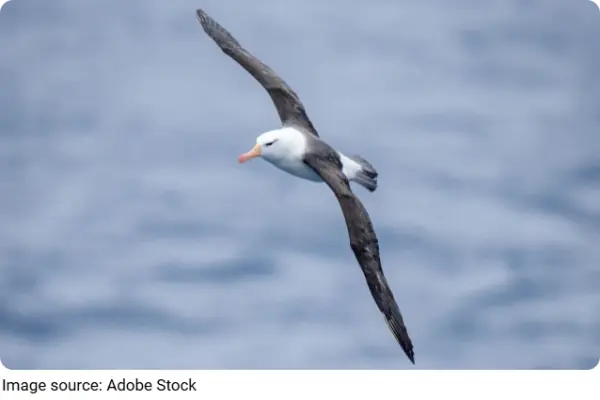
At first glance, the Black-browed Albatross appears too large for efficient flight. Reaching up to 100 cm in length and weighing between 3 to 5 kilograms, it seems like it should struggle to stay aloft. Instead, it excels. Its advantage comes from a technique known as dynamic soaring. By exploiting wind gradients just above the ocean’s surface, the bird can travel vast distances without constant wingbeats.
It locks its wings and glides between layers of moving air, extracting energy from the wind itself. This method is so efficient that its heart rate in flight remains close to its resting level—an extraordinary adaptation among birds. Under favorable wind conditions, it can reach speeds of up to 110 km/h. This is not about speed alone, but about endurance—covering immense stretches of ocean where food is scattered and unpredictable.
2. Opportunistic Feeding in a Competitive Ocean
Rather than specializing in a narrow diet, the Black-browed Albatross survives through adaptability. It primarily feeds on fish, squid, crustaceans, and carrion, typically taking prey from the ocean’s surface. Unlike deeper-diving seabirds, it rarely descends beyond 5 meters. Its feeding behavior becomes especially intense around fishing vessels.
Trawlers unintentionally provide discarded bycatch and offal, attracting large flocks. Here, feeding turns chaotic. Birds jostle, chase, and even steal food mid-air from one another. While they may gather in groups, cooperation is absent—competition defines every interaction. One of its more unusual adaptations is the production of stomach oil, a dense, energy-rich substance. This oil serves a dual purpose: it acts as a high-calorie reserve for long journeys and can be forcefully ejected at threats as a defensive measure.
3. Life on the Edge: Breeding in Harsh Landscapes
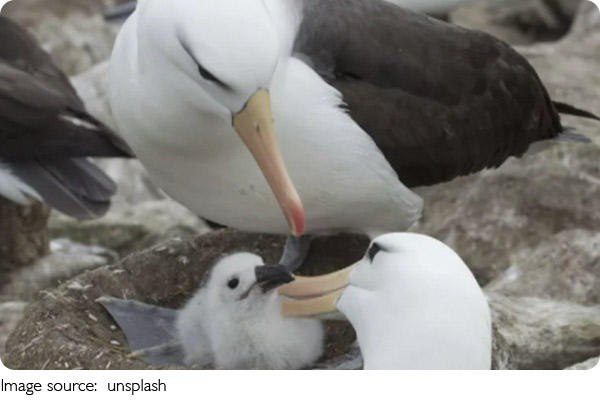
Despite spending most of its life at sea, the Black-browed Albatross returns to land with precision during the breeding season. Colonies are typically established on steep cliffs or exposed coastal edges, locations that reduce access for predators. In contrast, populations in the Falkland Islands often nest on flatter grasslands, showing some ecological flexibility.
Breeding generally occurs between late September and early November, though timing can vary by region. The reproductive strategy is slow and deliberate:
- Only one egg is laid per breeding cycle
- Both parents share incubation duties for around 70 days
- Chicks remain dependent for approximately four months before fledging
This low output is offset by high parental investment. Each chick represents a significant commitment of time and energy.
These birds are monogamous, forming long-term pair bonds. Courtship rituals—elaborate sequences of calls and synchronized movements—are practiced years before actual breeding begins. Juveniles often return to colonies at around three years old but typically delay reproduction until at least seven.
Black-browed Albatross facts 🦩 Black-browed Mollymawk 🦩
Amazing Planet!
4. Longevity and Population Pressure
With lifespans exceeding 70 years, Black-browed Albatrosses are built for longevity rather than rapid reproduction. This strategy stabilizes populations over time but makes them vulnerable to sustained threats. A large proportion of the global population—around 75%—breeds in the Falkland Islands and South Georgia.
This concentration increases risk, as disturbances in these regions can have widespread consequences. The most significant modern threat comes from longline fishing, where birds are accidentally hooked and drowned. On land, introduced species such as rats prey on eggs and chicks, while rabbits degrade nesting areas through burrowing activity.
5. Anatomy of Survival
Several specialized features highlight how precisely adapted this species is to marine life:
- A salt-excreting gland above the nasal passage allows it to process seawater efficiently
- Its wing structure is optimized for long-distance gliding with minimal energy loss
- The distinctive dark eyebrow aids in visual recognition among densely packed colonies
Even its scientific name, melanophris, reflects this signature trait, derived from Greek words meaning “black” and “eyebrow.”
The Black-browed Albatross is not simply a strong flier—it is a species that has minimized the cost of movement to an extreme degree. The ocean is not an obstacle to cross, but a dynamic surface to navigate with precision.