Dusky Leaf Monkey: 5 Facts!

Amina Hassan
| 22-05-2026
 · Animal team
Have you ever seen a monkey with bright orange fur that later changes into a smoky gray coat as it grows? Readers, the Dusky Leaf Monkey is one of Southeast Asia’s most fascinating forest animals.
Found in coastal forests, limestone hills, and mangroves, this quiet tree-dweller spends much of its time high in the canopy. Behind its calm behavior lies a surprising mix of unusual habits and clever adaptations.
1. Their Babies Look Completely Different From Fully Grown Monkeys
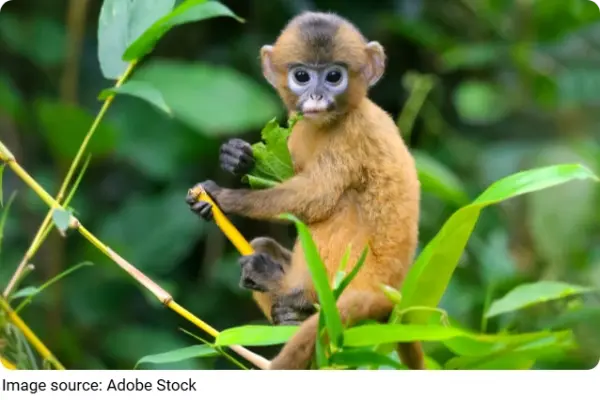
One of the most striking features of dusky leaf monkeys appears at birth. Infants enter the world covered in vivid orange fur, with pale face markings and tiny expressive eyes. This dramatic color stands in sharp contrast to the dark gray or charcoal coats of mature individuals.
Scientists believe this bright coloring serves an important social purpose. The orange coat may encourage caregiving within the group by making infants highly visible and instantly recognizable. Females other than the mother frequently handle, groom, and carry newborns, a behavior known as allomothering. Such communal care helps reduce pressure on mothers and increases protection for vulnerable young.
As months pass, the bright fur gradually fades into darker shades. By around three to five months of age, the transformation becomes noticeable, eventually giving young monkeys the smoky appearance typical of fully grown individuals. Watching this change is like seeing nature quietly rewrite an animal’s identity in stages.
2. They Digest Leaves With a Stomach More Similar to a Cow Than a Monkey
Unlike monkeys that feast on fruit or insects, dusky leaf monkeys belong to a group called colobines, primates specially adapted for leaf eating. Leaves are difficult to digest because they contain cellulose and defensive plant chemicals. Eating them efficiently requires biological engineering.
Dusky leaf monkeys possess a chambered stomach filled with microbes that ferment plant material before digestion continues. In practical terms, their digestive system works somewhat like that of ruminant animals, although they do not chew cud like many grazing mammals. This adaptation allows them to feed on mature leaves, young shoots, flowers, seeds, and occasionally fruit when available. However, they must choose carefully. Researchers observing wild populations have found that these monkeys often select younger leaves because they contain more nutrients and fewer toxins than older foliage.
You may also notice another curious habit: long periods of resting after meals. Digesting fibrous plant matter demands energy and time, so quiet sitting in the canopy is not laziness—it is part of an efficient survival strategy.
3. Their “Spectacles” Are Real Natural Markings
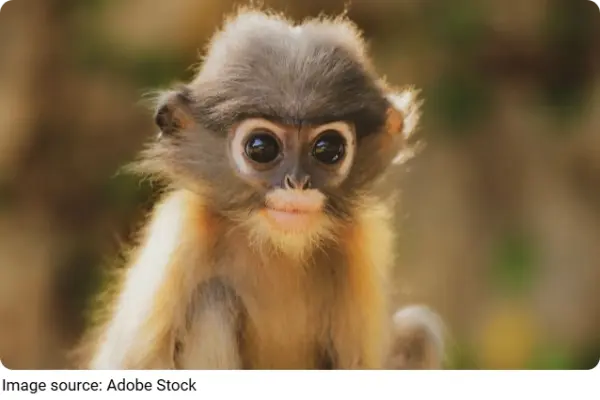
If dusky leaf monkeys look permanently surprised, there is a reason. Pale white circles surrounding their eyes resemble eyeglasses, giving rise to the nickname “spectacled langur.” These markings are not random decoration. Facie patterns help primates recognize one another and communicate socially. In dense forests where visibility changes constantly, subtle face differences can help identify group members or interpret expressions.
The face itself creates an unforgettable contrast: dark fur frames soft white patches around the mouth and eyes, producing a mask-like appearance. Combined with their large eyes and gentle posture, dusky leaf monkeys often appear unusually expressive compared with many other primates.
Interestingly, their visual communication tends to remain quiet and restrained. Rather than dramatic face threats seen in some monkey species, dusky leaf monkeys often rely on calm body language, spacing, and soft vocal sounds to maintain social harmony.
4. They Live in Peaceful Social Groups With Shared Responsibilities
Dusky leaf monkey groups are generally smaller and calmer than the noisy troops often associated with macaques. A typical group may include one fully grown male, several females, and young offspring, though social structure can vary depending on habitat and competition.
Conflict inside these communities appears relatively limited. Grooming plays a major role in strengthening social ties, reducing tension, and reinforcing trust. Mothers frequently receive assistance from other females when caring for infants, creating a network of shared responsibility. Communication also happens through subtle vocalizations.
Soft calls help maintain contact among individuals hidden by thick foliage. Alarm signals may be used if danger approaches, especially from predators such as large snakes, birds of prey, or forest carnivores. Because they spend much of their lives in trees, cooperation becomes essential. Staying connected without attracting attention helps the group move safely through forest canopies while conserving energy.
5. Limestone Forests Are Surprisingly Important to Their Survival
Many people imagine tropical monkeys living only in dense rainforests, but dusky leaf monkeys often depend heavily on limestone ecosystems. Towering karst cliffs and rocky forest patches provide shelter, food diversity, and elevated sleeping locations.
In several regions of Southeast Asia, populations thrive near limestone hills where vegetation growing on mineral-rich rock supports varied feeding opportunities. Unfortunately, these habitats face increasing pressure from quarrying, tourism expansion, and forest fragmentation. Habitat loss creates more than a housing problem. Since dusky leaf monkeys rely on connected tree cover for movement, broken forest patches can isolate groups and limit access to food sources. Roads and human development may also increase dangerous encounters. Protecting these landscapes supports not only the monkeys but entire ecological communities living in fragile limestone environments.
Friends, dusky leaf monkeys may not dominate wildlife documentaries with dramatic fights or loud displays, but their lives reveal a quieter kind of brilliance. From glowing orange infants and specialized stomachs to peaceful group living and unforgettable “spectacles,” every detail tells a story of careful adaptation.