Plants
The Secret Mushroom Glow
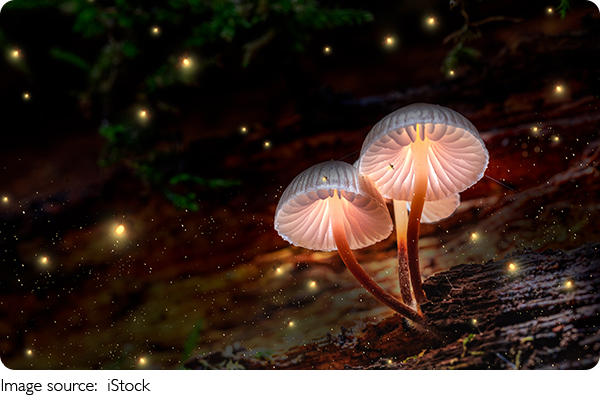
Have you ever walked through a forest at night and noticed a faint greenish glow coming from what looked like an ordinary mushroom, Lykkers? It sounds almost magical, but bioluminescent fungi produce real light through a chemical reaction inside their living tissues.
More than 100 fungal species are known to bioluminesce, with examples found on several continents and across different fungal groups. The glow is usually subtle rather than bright enough to illuminate a forest path. Yet in complete darkness, a cluster of luminous mushrooms can appear surprisingly vivid.
The Chemistry Behind the Glow
Bioluminescence occurs when a living organism produces light through a chemical reaction. In fungi, the process belongs to a biochemical pathway involving compounds known as luciferin and enzymes called luciferases. In the fungal system, the molecule 3-hydroxyhispidin has an important role. It is produced from hispidin, a compound synthesized by fungal enzymes. When the relevant luciferin interacts with oxygen in the presence of fungal enzymes, the reaction releases energy as visible light.
The result is called bioluminescence, meaning the organism itself generates the illumination rather than merely reflecting moonlight or another external source. The color produced by many luminous fungi is typically green, although the exact appearance can vary depending on the species and viewing conditions. The light may be difficult to see around a bright campsite but much easier to notice after the eyes have adapted to darkness.
Not Every Part of a Glowing Fungus Shines
One fascinating detail is that fungal bioluminescence does not necessarily appear throughout the entire organism. In some species, light is concentrated in the mushroom's cap or other reproductive structures. In others, the mycelium, which consists of a network of microscopic fungal threads, can also produce a visible glow. The famous phenomenon sometimes called "foxfire" is associated with luminous fungal mycelium or decaying wood colonized by glowing fungi. In a dark woodland, small patches of infected material may appear to emit a dim green light.
This distinction matters because the mushroom visible above the soil is only part of a much larger fungal organism. Beneath or within its surroundings, extensive mycelial networks may be carrying out decomposition and nutrient acquisition.
Why Would a Fungus Spend Energy Making Light?
Producing light requires biochemical resources, so researchers have long questioned what advantage the glow provides. One leading explanation involves insects. Some luminous fungi produce light from their reproductive structures, potentially making them more noticeable to nocturnal insects. When insects visit a glowing mushroom, they may inadvertently pick up fungal spores and transport them to another location.
Spores are essential for fungal reproduction because they allow the organism to colonize new environments. Insects could therefore function as accidental transportation services. Fungal illumination can influence animal behavior. Still, the insect-attraction explanation may not apply equally to every luminous species. Bioluminescence could have different ecological roles depending on where a fungus lives and which animals interact with it.
The Glow May Be Part of a 24-Hour Rhythm
Some luminous fungi do not shine at exactly the same intensity throughout the day. Researchers studying certain bioluminescent mushrooms have found evidence of circadian regulation, meaning the light-producing machinery can follow an internal daily rhythm. In some species, luminescence is stronger at night and weaker during the day.
This timing makes ecological sense if nocturnal insects are important visitors. Producing the strongest signal when potential nighttime carriers are active could make the energy cost of illumination more worthwhile. The rhythm also demonstrates that fungal bioluminescence is not simply a passive chemical reaction that happens whenever the necessary substances are present. In some fungi, biological systems regulate when the chemistry becomes most active.
Why the Glow Is Usually So Dim
A glowing mushroom rarely resembles a bright lamp. Its light is often weak because the biological system is optimized for signaling or ecological interaction rather than illuminating a large area. Human eyes are particularly poor at seeing color in extremely low light, so the glow may appear almost gray-green at first. After spending several minutes in darkness, however, the eyes become more sensitive, making faint luminescence easier to detect.
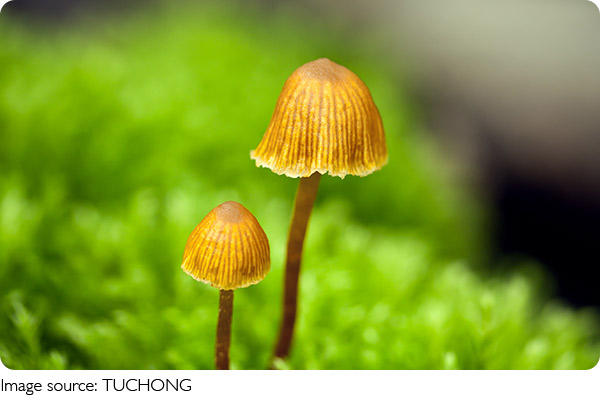
Some mushrooms glow because their cells contain a specialized biochemical pathway capable of converting chemical energy into visible light. So, the next time a faint green shimmer appears on a fallen branch, look a little closer. What seems like a mysterious forest light may actually be the visible trace of an intricate relationship between fungi, chemistry, insects, and decomposition. If you ever encounter a glowing mushroom in the wild, would you notice the faint light first, or the hidden fungal world responsible for creating it?